Nothing Ear vs Nothing Ear (a): Which to Buy?
Affiliate disclosure: this article contains Amazon affiliate links. If you buy through them, we may earn a commission at no extra cost to you. This never affects how we rank products — see how we review.
Comparison Table
| # | Product | Our Score | Price | Buy |
|---|---|---|---|---|
| 1 | Nothing Ear (a) Wireless Earbuds, 45dB Hybrid Noise Cancelling Earbuds, Hi-Res Audio, Advanced Equaliser, Dual Connect, 6 Mics, 42.5H Playtime Ear Buds Wireless Bluetooth, Black Best Overall | 8.4/10 | $55 | Check Price on Amazon |
| 2 | Nothing Ear Wireless Earbuds Bluetooth, 45dB Hybrid Smart ANC Earbuds, 11mm Deep Bass Boost, Hi-Res Audio with LDAC & LHDC 5.0, 6 Mics Call, 40.5H Playtime with Fast Charging Case, ChatGPT Supported Runner-Up | 8.2/10 | $69 | Check Price on Amazon |
Prices as of October 8, 2026 — check Amazon for the latest price and availability.
Top Picks for You

Nothing Ear (a) Wireless Earbuds, 45dB Hybrid Noise Cancelling Earbuds, Hi-Res Audio, Advanced Equaliser, Dual Connect, 6 Mics, 42.5H Playtime Ear Buds Wireless Bluetooth, Black
Price as of October 8, 2026 — check Amazon for the latest price.
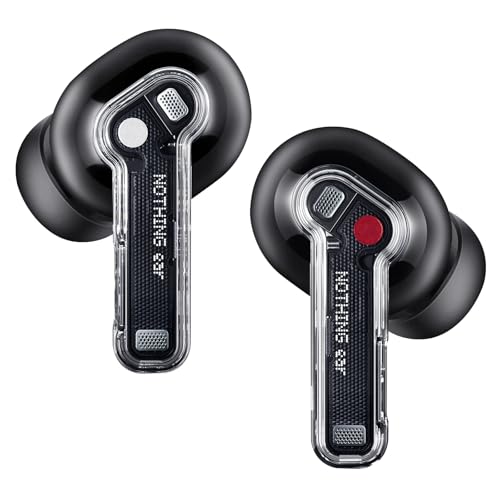
Nothing Ear Wireless Earbuds Bluetooth, 45dB Hybrid Smart ANC Earbuds, 11mm Deep Bass Boost, Hi-Res Audio with LDAC & LHDC 5.0, 6 Mics Call, 40.5H Playtime with Fast Charging Case, ChatGPT Supported
Smart Noise Cancelling: Nothing but the music. Nothing ear wireless earbuds with up to 45 dB Active Noise Cancellation, Ear features our most effective and intelligent noise cancelling powers yet. Now 1.8x stronger than others. Ear automatically checks for noise leakage between the earbud and your ear canal, then applies more noise cancellation to make up for it. So you receive the best possible noise cancellation Clear Voice Technology: HiRes Wireless Audlio, Nothing Ear buds supports high resolution streaming over Bluetooth. The result is powerfully pure audio with no quality damage. Just how the artistintended. Up to 1 Mbps 24 bit/192 kHz with LHDC 5.0 and up to 990 kbps with frequencies up to 24 bit/96 kHz with LDAC, Requires devices that support LHDC or LDAC, Nothing wireless Ear isolates your voice from everyday distractions so calls on-the-go feel like face-to-face conversations. Long Playtime, Fast Charging: Ear supports up to 2.5W wireless charging. Power-up on-the-go with reverse charge on compatible devices, like Phone (2). Powered to go further, Ear lasts 25% longer than Ear (2) on a single charge. Or top-up in the case and use consistently for over 40.5 hours (ANC turned off). For speedy power-ups, Ear can Fast Charge for 10 minutes and deliver 10 hours of playback (with ANC turned off) Custom Ceramic Driver: Nothing Ear ultra compact but beyond powerful. Our 11 mm driver delivers an unbeatable audio experience.Coupled with a new ceramic diaphragm, we’ve increased airflow by 10% within each bud. For less distortion and richer clarity. Plus, advanced voice pickup tech cuts through background noise so your calls sound natural, like you’re talking face to face. More Performance: Stay connected to two devices at the same time. Play music on your laptop then seamlessly switch to answer a call on your phone. Effortless. Reduce audio lag for seamless gaming. Triggered automatically in Game Mode on a Nothing phone. With end-to-end latency at less than 120 ms. Microsoft Swift Pair, LED charging status, Pinch controls, Find My Earbuds, Water resistance IP54 buds / IP55 case, Google Fast Pair, Ear Tip Fit Test supported.
Limited time deal — ends October 12
Price as of October 8, 2026 — check Amazon for the latest price.
The Short Answer
Buy the Ear (a). It costs less, quotes more battery, carries the same cancellation figure, and is the better-liked of the two among people who own them.
Buy the Ear only if you want wireless charging, or have a phone that supports LHDC and you actually listen to hi-res files or streams. Both support LDAC, so for most people the real difference is a feature they will never switch on.
What Is Actually Different
The cancellation figure is identical. Both quote up to 45dB of hybrid active noise cancellation. Whatever else separates these earbuds, the headline number does not.
The cheaper one quotes more battery. The Ear (a) claims 42.5 hours in total; the Ear claims 40.5. That is a small gap, and it runs the wrong way for a product that costs more.
The Ear adds LHDC 5.0, a ceramic driver and wireless charging. Both models support LDAC, so the codec upgrade is LHDC alone. It matters only if your phone supports it — a smaller set of Android phones than LDAC — and your source material justifies it. iPhones support neither codec.
The Ear has a larger driver with a bass boost, where the Ear (a) leans on its equaliser instead. Expect a fuller low end from the more expensive pair and a more adjustable one from the cheaper.
Both have six microphones for calls, both support dual connection to two devices, and both are tuned by the same company with the same app behind them.
What the Extra Money Really Buys
The gap between them moves around, and that cuts both ways: it is easy to spend and easy to waste. Check both prices on the day rather than assuming the order.
If you are on iPhone, it is mostly wasted. Neither LDAC nor LHDC works there. You would be paying for a ceramic driver and wireless charging, and losing two hours of quoted battery.
If you have an LHDC-capable Android phone and care about hi-res audio, or you want wireless charging, it is well spent. Those are the two things the cheaper model cannot be made to do through settings.
If you mostly listen to Spotify, podcasts and YouTube, it is wasted. Those are compressed sources, and better codecs give you very little to work with.
There is also the owner verdict to weigh. The cheaper model has both a larger base of owners behind it and a marginally better standing among them, which is not what you would expect if the price gap bought a clearly better product.
Nothing Ear (a) Wireless Earbuds
The one to buy for most people, and the reason is that it gives up almost nothing.
Up to 45dB of hybrid cancellation, 42.5 hours of total playtime, six microphones, dual connection, LDAC hi-res support and an adjustable equaliser — at the lower price of the two. The transparent design is the reason many people choose the brand at all, and it is here unchanged.
What you give up: LHDC, the ceramic driver and wireless charging. If none of those means anything to you, you are not giving up anything at all. Our Nothing Ear (a) review covers it on its own, including its battery with cancelling on.
Check Price on Amazon · $55 as of October 8, 2026 — check Amazon for the latest price.
Nothing Ear Wireless Earbuds Bluetooth
The better pair on paper, for a narrower audience than the price suggests.
LHDC 5.0 puts it ahead for anyone with an LHDC-capable Android phone and hi-res sources, wireless charging is a genuine convenience, and its 11mm driver uses a ceramic diaphragm aimed at lower distortion. Fast charging is included, and the app adds ChatGPT support, which is an unusual inclusion and worth exactly as much as you want it to be.
The awkward part is the battery: 40.5 hours against the cheaper model's 42.5. Paying more for less playtime is a hard thing to justify, and it is the clearest sign that this is a sideways step for most buyers rather than an upgrade.
Check Price on Amazon · $69 as of October 8, 2026 — check Amazon for the latest price.
How to Decide
What phone do you use? iPhone, buy the Ear (a) — the upgrade does not work on your device. Recent Android, the Ear becomes worth considering.
Do you listen to hi-res audio? If you cannot name the last lossless file you played, this difference is not for you.
Do you want more bass by default? The Ear. Do you want to shape it yourself? The equaliser on the Ear (a) does that.
Is battery a deciding factor? Then it points at the cheaper one, which is an unusual sentence to write.
Considering other options at this price? See best wireless earbuds under $100, or best TWS earbuds for 2026 for the category more broadly.
FAQ
What is the difference between Nothing Ear and Nothing Ear (a)? Codecs, driver and charging. Both support LDAC; the Ear adds LHDC 5.0, a ceramic driver and wireless charging. The cancellation figure is the same on both, and the Ear (a) quotes slightly more battery.
Which has better noise cancelling? Both quote up to 45dB of hybrid cancellation. On the specification there is nothing between them.
Is the Nothing Ear worth the extra money? Only with an Android phone that supports LHDC and hi-res sources to play through it, or if you want wireless charging. Otherwise you are paying more for less battery.
Which has longer battery life? The cheaper Ear (a), at 42.5 hours total against 40.5 for the Ear.
Do these work with an iPhone? Yes, both do — but the hi-res codecs that justify the Ear's price do not, which makes the Ear (a) the sensible choice on iOS.
Do both support connecting to two devices? Yes. Dual connection is on both, so a laptop and a phone can stay paired at once.
Verdict
The Nothing Ear (a) is the better buy for most people. Same cancellation figure, more quoted battery, lower price, and the larger group of satisfied owners. Nothing about it feels like the cheap option except the price.
The Nothing Ear earns its premium in one specific situation: a recent Android phone, hi-res sources, and enough interest in audio quality to have an opinion about codecs. In that case LHDC is a real capability the cheaper pair cannot match at any setting, and wireless charging comes with it.
Everyone else should take the saving and the extra two hours of battery. When the cheaper model in a lineup is both better-liked and longer-lasting, the naming is doing more work than the hardware.
Written by
HeadsetAtlas Editorial TeamOur recommendations are research-driven: we analyze technical specifications, aggregate thousands of verified user reviews, and cross-reference expert sources to score every product. Read our full review methodology →