ATH-M20x vs M30x: Which Studio Monitor Should You Buy?
Affiliate disclosure: this article contains Amazon affiliate links. If you buy through them, we may earn a commission at no extra cost to you. This never affects how we rank products — see how we review.
Comparison Table
| # | Product | Our Score | Price | Buy |
|---|---|---|---|---|
| 1 | Audio-Technica ATH-M30x Professional Studio Monitor Headphones, Black Best Overall | 8.2/10 | $79 | Check Price on Amazon |
| 2 | Audio-Technica ATH-M20x Professional Studio Monitor Headphones, White Best Budget | 8.1/10 | $59 | Check Price on Amazon |
Prices as of September 23, 2026 — check Amazon for the latest price and availability.
Top Picks for You
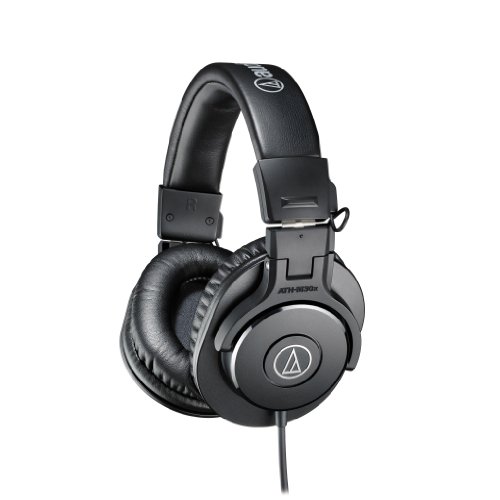
Audio-Technica ATH-M30x Professional Studio Monitor Headphones, Black
The step above the M20x, and the point in Audio-Technica's range where the tuning turns toward mixing. Same 40 mm driver construction, tuned for detail and midrange definition instead of low-end weight, which keeps vocals and instruments separable on dense material. Closed-back and circumaural with good isolation, and it collapses for transport, which the M20x does not. The cable is still fixed rather than detachable.
Price as of September 23, 2026 — check Amazon for the latest price.

Audio-Technica ATH-M20x Professional Studio Monitor Headphones, White
Audio-Technica's cheapest studio monitor, and the usual first step into real monitoring. Its 40 mm drivers are tuned for low-frequency weight, which makes it a comfortable headphone for tracking and long practice sessions rather than a revealing one for mixing. Closed-back, circumaural, and isolating enough for a room with a live source in it. The cable is fixed and exits one side; when it fails, the headphone is finished.
Price as of September 23, 2026 — check Amazon for the latest price.
What Is Actually Different
Most comparisons at this end of the market have to invent distinctions. This one does not, because Audio-Technica states it directly. Both models use 40 mm drivers with the same magnet and voice-coil construction, both are closed-back, and both use a fixed single-side cable. What the manufacturer says differs is the tuning:
- M20x — tuned for enhanced low-frequency performance
- M30x — tuned for enhanced detail, with midrange definition
That is not marketing gloss; it maps onto what the two are for. A monitor tuned for low-end weight is a comfortable tracking headphone. A monitor tuned for midrange definition is a better one to make decisions on.
The M30x is also collapsible, which the M20x is not — a small thing that matters if it lives in a bag.
Audio-Technica ATH-M30x Professional
The one to buy if you will make judgements with them. Its midrange presentation keeps vocals and instruments separable where the M20x lets them run together, which is what you need when deciding whether a mix is working rather than simply whether a take was clean.
The isolation is good, the fit is comfortable for long sessions, and it folds for transport.
Its limits are the ones the whole range shares at this price: a fixed cable, so a cable failure ends the headphone, and a narrow soundstage typical of closed-backs. It costs about a third more than the M20x for a difference that is real but not dramatic.
Check Price on Amazon · $79 as of September 23, 2026 — check Amazon for the latest price.
Audio-Technica ATH-M20x Professional
The one to buy if you are tracking, practising or learning. Its low-frequency weight makes it a more comfortable long-session headphone, and for recording — where the job is hearing whether the take is clean — the extra detail of the M30x earns you little.
It is the cheaper way into genuine studio monitoring, and it is where most people should start. Our ATH-M20x review covers it on its own terms.
Where it runs out is separation on dense material, and that is precisely the gap the M30x fills.
Check Price on Amazon · $59 as of September 23, 2026 — check Amazon for the latest price.
How to Choose
Tracking, practice, learning: M20x. The extra low-end weight is more pleasant over hours, and detail you are not using is not worth $20.
Mixing, editing, critical listening: M30x. Midrange definition is the property those jobs depend on.
Both live in a bag: M30x. It collapses; the M20x does not.
Neither, if you need a detachable cable. Both use a fixed one. That starts at the M40x in this range, and it is the single most common cause of a dead pair.
Neither, if you will mix seriously. Closed-backs at this price have a narrow soundstage. Our best studio headphones for home recording guide covers what more money buys.
FAQ
Is the M30x worth $20 more than the M20x? If you will make mixing decisions, yes — midrange definition is what those decisions rest on. If you are tracking or practising, the M20x does that job and the money is better saved.
Do they use the same drivers? Both use 40 mm drivers with the same magnet and voice-coil construction. The tuning differs; the hardware is closely related.
Does either have a detachable cable? No. Both use a fixed single-side cable. Detachable cables start at the M40x in this range.
Which is more comfortable? They are close. Both are circumaural with similar clamping. The M30x folds, which matters for transport rather than comfort.
Can I use either without an amplifier? Yes. Both run adequately from a laptop, phone or audio interface.
Which is better for casual listening? The M20x, marginally — its low-frequency tuning flatters music more. Neither is built to flatter, which is the point of a monitor.
Verdict
For most buyers the ATH-M20x is the right purchase: it is the cheaper entry to real monitoring, its tuning is more forgiving over long sessions, and tracking does not need what the M30x adds.
Step up to the ATH-M30x for one specific reason — you will be deciding whether a mix works, and midrange definition is what that decision rests on. It also folds, which the M20x does not.
Neither has a detachable cable, and on both that is the part most likely to end the headphone's life. If that matters more to you than the tuning difference, the money is better spent higher up the range than between these two.
Written by
HeadsetAtlas Editorial TeamOur recommendations are research-driven: we analyze technical specifications, aggregate thousands of verified user reviews, and cross-reference expert sources to score every product. Read our full review methodology →